
Natural Stone: The Story, Types and Beauty of Earth’s Stone
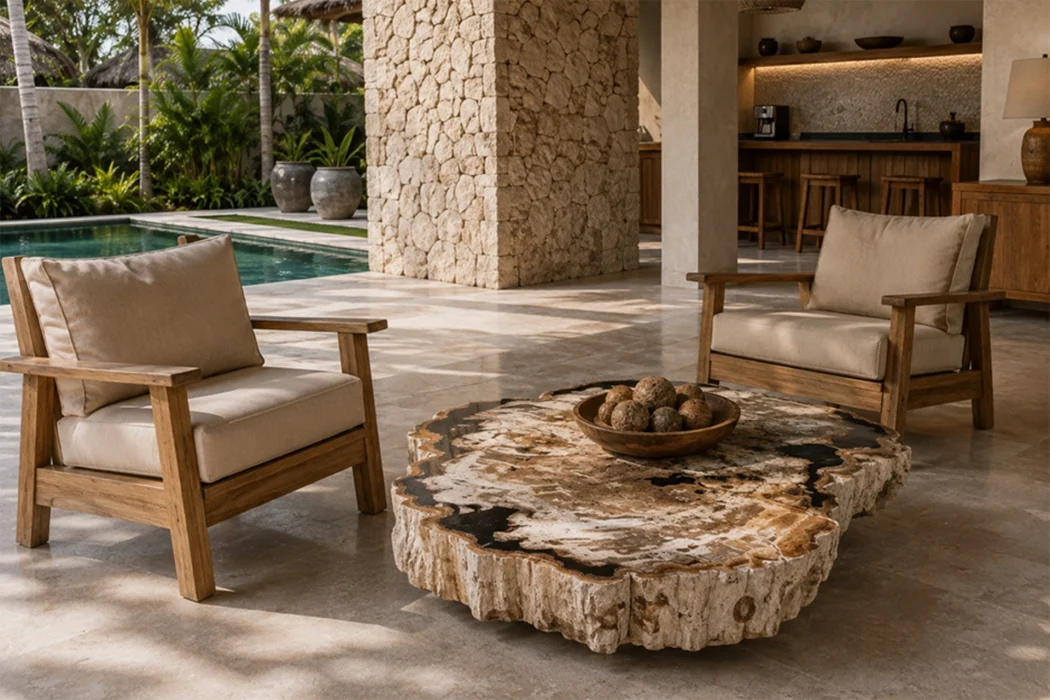
Natural stone has been used by people for thousands of years. Long before modern concrete, steel, and manufactured materials, civilizations used stone to build homes, temples, monuments, roads, floors, and furniture.
Today, natural stone is still widely used in architecture and interior design. It can be found in villas, hotels, resorts, restaurants, bathrooms, kitchens, gardens, and furniture.
For Bali Agung Furniture, natural stone is another material that works naturally with teak, rattan, linen, and other organic materials.
But what exactly is natural stone, where does it come from, and why is it so useful?
What Is Natural Stone?
Natural stone is rock that comes directly from the earth and is cut, shaped, and finished for use.
The rocks used for architectural and furniture applications are often called dimension stone. They are quarried as blocks or slabs and selected for qualities such as color, pattern, strength, durability, and ability to take different finishes. (usgs.gov)
Natural stone is made from minerals. Different combinations of minerals create different colors, textures, patterns, and physical properties.
There are three main geological groups:
- Igneous stone — formed from cooled molten rock
- Sedimentary stone — formed from accumulated sediments
- Metamorphic stone — formed when existing rock changes under heat and pressure (usgs.gov)
This geological history is what gives every stone its individual character.
1. Granite
Granite is one of the best-known natural stones.
It is an igneous rock, formed when molten rock cools slowly beneath the Earth’s surface. This slow cooling allows crystals such as quartz and feldspar to develop, creating the familiar grainy appearance of granite. Because of these properties, granite has traditionally been used for buildings, monuments, bridges, countertops, flooring, and other architectural applications. For furniture, granite can be used for tabletops, side tables, consoles, and architectural surfaces.
2. Marble
Marble has been used in architecture and sculpture for centuries.
Geologically, marble begins as limestone. Under heat and pressure inside the Earth, the limestone recrystallizes and becomes marble. This process creates the characteristic crystalline structure and flowing patterns associated with marble.
White marble is particularly famous, but marble can also appear in shades of grey, beige, green, brown, pink, and other colors depending on its mineral composition. Marble is commonly used for tabletops, bathroom surfaces, flooring, wall panels, sculptures, and decorative furniture.
Because marble is primarily composed of calcite, it can be more sensitive to acids than stones such as granite. Proper selection and care are therefore important depending on its application.
3. Limestone
Limestone is a sedimentary rock.
It commonly forms from accumulated shells, fossils, and other calcium-carbonate-rich material deposited in ancient seas and lakes. Over long periods, these sediments become compacted and form limestone.
One interesting feature of limestone is that fossils or fossil fragments can sometimes be seen within the stone. It is often used for walls, flooring, facades, garden features, architectural details, and decorative furniture. Its softer and more porous nature means that the right type and finish should be selected carefully for each project.
4. Sandstone
Sandstone is another sedimentary rock.
It forms when grains of sand are deposited, compacted, and cemented together over geological time. The original sand and the minerals binding it together influence its color and texture. It has traditionally been used for buildings, walls, paving, monuments, and landscaping. For modern projects, sandstone can create a softer and more natural appearance, especially when combined with timber and other organic materials.
5. Slate
Slate is a metamorphic rock.
It begins as an existing rock and is changed by heat and pressure inside the Earth. Slate has a natural structure that allows it to split into relatively thin sheets. This makes slate particularly useful for: Flooring, Wall cladding, Roofing, Decorative panels, Outdoor applications, Table and furniture surfaces.
Slate is often available in dark grey, black, green, purple, and other natural tones. Its layered appearance can add a more earthy and architectural feeling to a space.
6. Travertine
Travertine is a type of limestone that forms when mineral-rich water deposits calcium carbonate, often around springs and other water environments.
It is recognizable by its natural pores and layered appearance. Travertine is popular for: Flooring, Bathrooms, Pool areas, Wall surfaces, Outdoor spaces, Tables and furniture.
Its warm beige and cream colors work particularly well with teak and rattan. For tropical and Mediterranean-inspired interiors, travertine and natural teak can create a very natural combination.
7. Basalt
Basalt is a dark-colored igneous rock formed from volcanic lava.
Because volcanic activity has shaped many parts of Indonesia, basalt is also part of the country’s natural geological landscape.
Basalt is generally dense and durable and is often used for: Paving, Walls, Landscaping, Steps, Architectural surfaces, Decorative objects. Its dark grey or charcoal appearance can provide an interesting contrast to lighter woods such as natural teak.
How Is Natural Stone Collected?
Natural stone is obtained from quarries.
A quarry is an area where suitable rock is extracted from the ground. The process begins by identifying a suitable stone deposit. The quarry is then developed to reach the desired rock formation.
Large blocks can be separated from the rock using controlled cutting, drilling, wire sawing, or other quarrying techniques. Modern dimension-stone quarrying aims to remove usable blocks while minimizing unnecessary damage and fractures. The large blocks are then transported for processing. The final finish changes not only the appearance but also how the stone feels and performs.
Why Is Natural Stone Good for Furniture?
Natural stone is especially interesting when combined with wood.
A teak table with a stone top, for example, combines two very different natural materials. Wood brings warmth. Stone brings weight, texture, and permanence. Together, they can create furniture that feels natural and architectural.
The stone selected should always match the intended application. Important considerations include hardness, porosity, durability, surface finish, and exposure to water or chemicals. These are also among the qualities used when evaluating dimension stone for architectural purposes.
Natural Variation Is Part of the Beauty
One of the most important things to understand about natural stone is that it is not a manufactured material. The color, grain, veining, pores, fossils, and mineral patterns can vary from one piece to another. Two slabs from the same quarry may not look exactly the same.
For many designers, this is one of the most attractive qualities of natural stone. The variations show that the material comes from nature rather than being produced to look identical.
Natural Stone Has a Long History
From ancient temples and monuments to modern hotels and private homes, natural stone has remained an important architectural material. Its popularity has changed over time, but the basic reason remains the same: stone combines natural beauty, physical strength, durability, and a sense of permanence.
Modern technology has made stone easier to cut and finish, but the material itself is still created by geological processes that can take millions of years. That is what makes natural stone different from many manufactured materials. Every piece carries a small part of the geological history of the earth.
Natural Stone for Furniture and Projects
For furniture and interior projects, the value of natural stone is not only its appearance.
It is the combination of geological history, natural variation, strength, texture, and craftsmanship.
At Bali Agung Furniture, natural stone can be combined with teak, rattan, and other natural materials to create furniture for villas, hotels, resorts, restaurants, residential interiors, and international projects.
The result is a connection between materials that come from very different parts of nature—wood from trees, rattan from climbing palms, and stone from the earth.