
Rattan Furniture: The History and Natural Beauty of Rattan
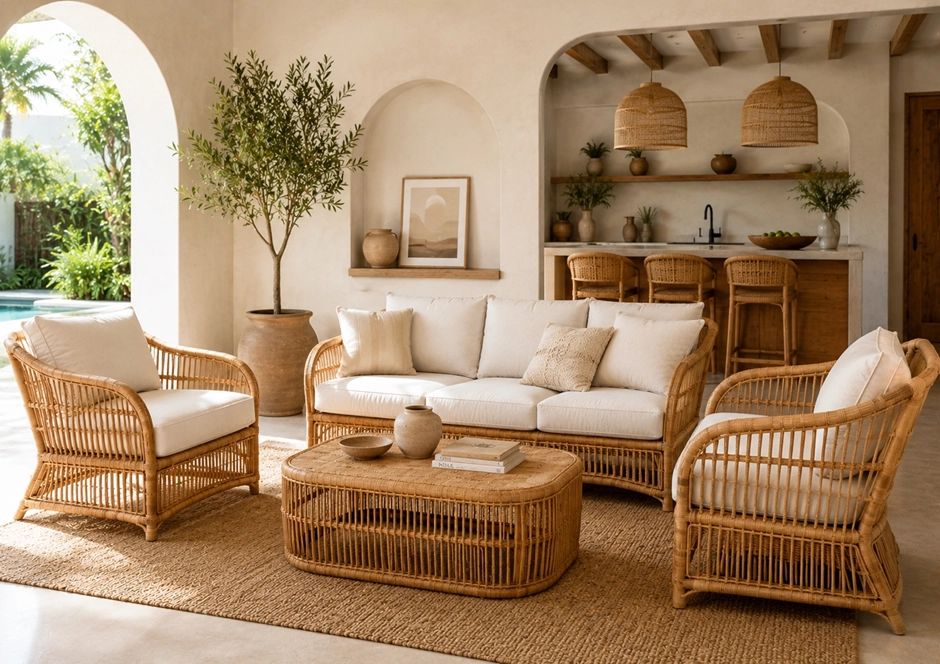
Rattan has been used in Southeast Asia for generations. Long before it became popular as a material for modern furniture, local communities used rattan for baskets, mats, household items, tools, and traditional crafts.
Today, rattan remains an important natural material for furniture, particularly in Indonesia and other tropical regions.
For Bali Agung Furniture, rattan is interesting not only because of its appearance, but because of its natural origin, growth, strength, flexibility, and long history of craftsmanship.
What Is Rattan?
Rattan is not a tree. It is a group of climbing palms belonging mainly to the palm subfamily Calamoideae.
The word “rattan” comes from the Malay word “rotan,” which is the traditional name for these climbing palms. There are around 600 species of rattan, grouped into different genera, although only a portion of them have significant commercial value.
Unlike bamboo, which is generally hollow, a rattan cane is a solid stem. This is one reason rattan can be strong while remaining flexible and relatively lightweight.
Where Does Rattan Grow?
Rattan naturally grows mainly in the Old World tropical and subtropical regions. Different species grow in different environments. Some grow in forest undergrowth, while others prefer areas where more sunlight reaches the forest floor. Some species can also grow in swampy or seasonally wet forests.
Indonesia is particularly important because many commercially useful rattan species are naturally found across the Indonesian islands.
For example, Calamus zollingeri is found in Sulawesi and the Moluccas and is used commercially for furniture frames. Another species, Calamus trachycoleus, is found in Kalimantan and is used for furniture and weaving.
How Does Rattan Grow?
Rattan begins its life from a seed.
Young plants can spend several years developing near the forest floor. When conditions provide enough light, the plant begins producing a climbing stem.
The stem grows upward and uses surrounding vegetation for support. Some rattan species can produce very long climbing stems.
Rattan is considered a relatively fast-growing natural material. Growth rates vary considerably by species and growing conditions. For example, cultivated Calamus caesius has been recorded growing approximately 2.9–5.6 meters per yearunder cultivation.
This relatively fast growth is one reason rattan has become an important renewable material.
Why Does Rattan Climb?
Rattan does not grow like a traditional tree.
Instead of producing a large trunk to support itself, many rattan species climb through the forest using surrounding trees and vegetation for support.
The plant has developed different structures, including spines and climbing organs, that help it move upward toward better light.
Once it reaches areas with sufficient sunlight, the plant can grow more actively.
This relationship with the forest is important. Rattan depends on the surrounding forest environment, which means responsible management of the forest is an important part of maintaining the resource.
Why Is Rattan Good for Furniture?
Rattan has several natural qualities that make it suitable for furniture.
Lightweight
Rattan furniture is generally lighter than many solid-wood furniture options. This makes chairs, lounge furniture, and other pieces easier to move and handle.
Flexible
Rattan can be heated, bent, shaped, and woven into different forms. This allows craftsmen to create curved furniture designs that would be difficult to produce from some other natural materials.
Strong
Although lightweight, properly selected and processed rattan can provide good strength for furniture applications.
Different rattan species have different characteristics, so choosing the correct species and cane size is important for the intended use.
Natural Texture
Rattan has a distinctive natural surface and warm appearance.
It works particularly well with other natural materials such as teak, linen, cotton, leather, stone, and natural fibers.
Versatile
Rattan can be used in many different furniture styles, from traditional Indonesian designs to modern and contemporary furniture.
How Is Rattan Used?
Rattan can be used in several different forms.
The whole cane can be used for furniture frames and structural components. It can also be split, peeled, or processed into smaller materials for weaving, baskets, mats, panels, and decorative details.
This gives craftsmen many possibilities when designing furniture.
A single piece of furniture may also combine different materials—for example, a teak frame with woven rattan, creating a balance between solid wood and natural fiber.
Rattan and Indonesian Craftsmanship
Rattan has a long history of use in Southeast Asian communities.
Before modern furniture manufacturing, people used rattan for practical everyday objects such as baskets, mats, bindings, and household products. Over time, these traditional skills developed into more sophisticated furniture-making techniques.
Indonesia’s long tradition of working with natural materials has helped make rattan an important part of its furniture industry.
The material is particularly suitable for handmade production because it can be shaped and woven by skilled craftsmen.
Rattan and Sustainability
Rattan is often described as a sustainable material because it can grow relatively quickly and can be harvested without cutting down the entire tree that supports it.
However, rattan is not automatically sustainable simply because it is a natural or fast-growing material.
The way it is harvested and managed is important.
Research has shown that over-exploitation of wild rattan and loss of tropical forest can threaten rattan resources. Sustainable harvesting requires appropriate management, regeneration, and protection of the forest environment.
For this reason, responsible sourcing is important when purchasing rattan furniture.
Rattan for Modern Furniture
Rattan can create a relaxed tropical feeling, but it can also be designed in a clean and contemporary way.
Combined with teak and neutral fabrics, it can become part of a modern natural interior rather than looking traditionally tropical.
The Timeless Character of Rattan
Rattan has remained useful for generations because it combines qualities that are difficult to find in one material: lightness, flexibility, strength, natural beauty, and versatility.
From a climbing palm growing in a Southeast Asian forest to a handcrafted chair in a hotel or villa, rattan goes through a long journey before becoming furniture.
That connection between nature, traditional craftsmanship, and modern design is what makes rattan an enduring material for furniture.
At Bali Agung Furniture, we continue to work with natural materials such as rattan and teak to create furniture for international residential, hospitality, and project applications.